Maintaining high grade floor finishes across commercial properties is one of the most valued operational standards an estate manager can deliver, and one of the most unforgiving when it is neglected. Visitors, clients and tenants notice a dull, stained concourse or a dirty warehouse aisle within seconds of walking into a facility, and that impression directly impacts brand reputation. Search interest in autonomous floor scrubbers and robotic floor care in the UK has grown sharply in recent months, as facilities managers actively look for ways to offset rising wage rates and mitigate chronic frontline recruitment shortages. This guide sets out how to calculate the real return on investment of an autonomous floor scrubber, where financial savings actually originate, and how UK facilities leaders can transition from manual cleaning to a reliable, cash flow positive cobotic operation.
Why Floor Care Economics Can No Longer Be Ignored
Under the Health and Safety at Work etc. Act 1974, commercial building operators have a statutory duty to maintain safe, slip free floor surfaces for staff and the public. Slips, trips and falls remain the single highest cause of non-fatal workplace injuries reported to the Health and Safety Executive, with wet or dirty hard floors contributing to the vast majority of commercial incidents.
Beyond safety compliance, manual floor maintenance carries a heavy, escalating financial burden. Floor care accounts for up to 40 percent of all routine cleaning hours in large format commercial venues. With successive increases in the UK National Living Wage alongside rising employer National Insurance and pension contributions, relying on manual staff to push or ride floor scrubbers across tens of thousands of square metres is rapidly becoming commercially unsustainable.

Equipment Operation and Facility Sanitisation Are Two Different Jobs
A common point of confusion for facilities managers evaluating automation is assuming that a robotic scrubber is meant to replace human cleaning teams entirely. In practice, automated floor scrubbing and high touch facility sanitisation are two separate operational disciplines, and understanding how they interact is essential to unlocking ROI.
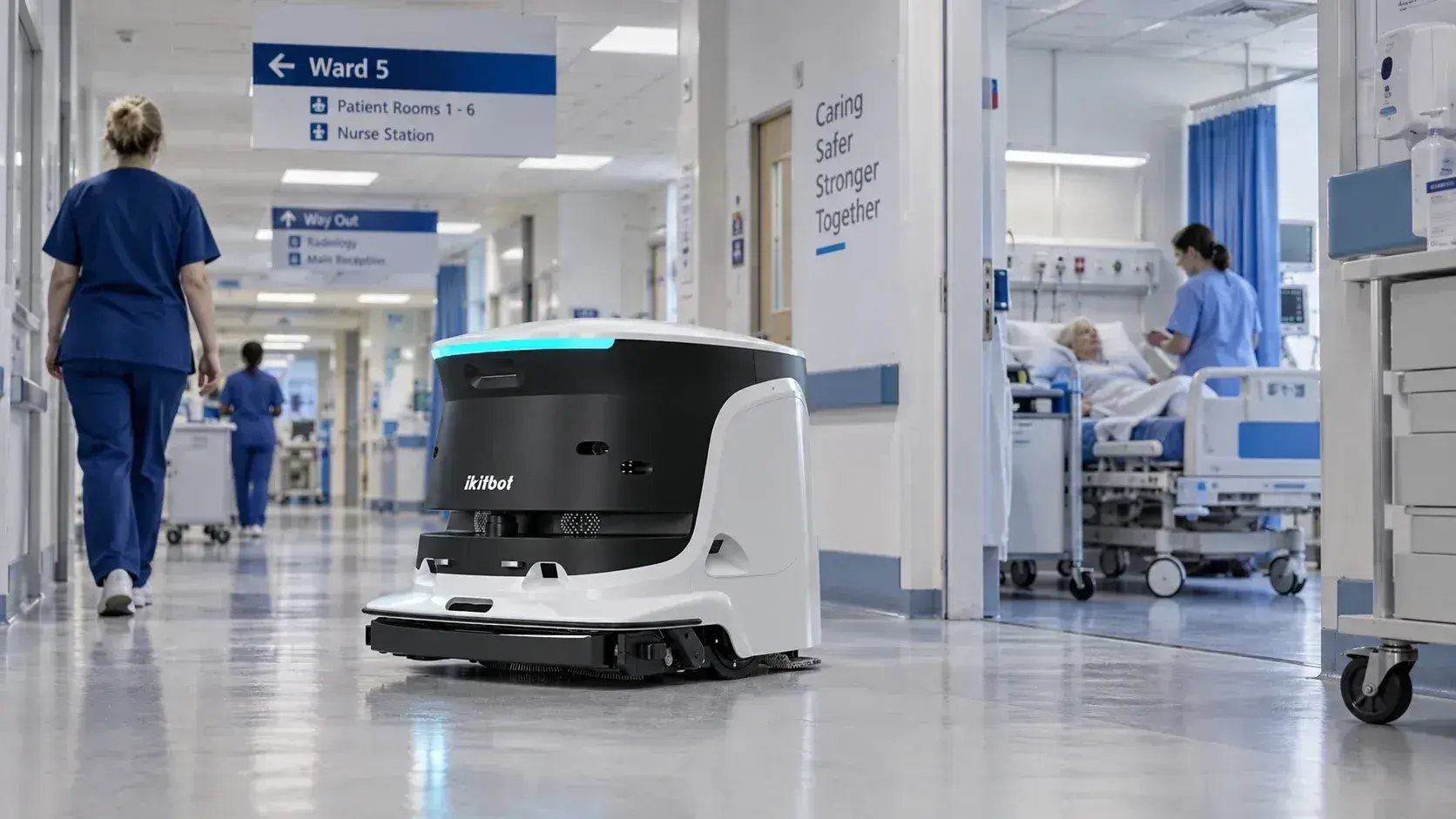
Automated floor care covers a wide area, repetitive scrubbing of open spaces like atrium concourses, logistics aisles, hospital corridors and campus hallways. This is heavy, highly predictable labour that autonomous equipment performs with consistent precision.
Facility sanitisation covers detailed, high touch tasks around the building: wiping door handles, sanitising washrooms, cleaning stairwells, servicing glass partitions and responding to localised spills. This is intricate, high value work that requires human judgement and agility. Bringing in an autonomous machine handles the wide area floor scrubbing so that skilled on-site personnel can focus on detailed sanitisation, transforming a fragile labour model into a resilient cobotic team.
Core Financial Drivers of Autonomous Scrubber ROI
A defendable business case for robotic floor care relies on four core operational pillars:
- Direct Labour Optimisation: eliminating manual floor machine pushing and reallocating worker hours to high priority cleaning tasks or offsetting overtime.
- Utility and Chemical Conservation: precise micro-dosing and automated water flow management that significantly reduce utility consumption.
- Consumable and Asset Longevity: constant, computer controlled pad pressure that extends the lifespan of brushes, squeegees and underlying floor seals.
- Digital Proof of Performance: automated telematics and route heatmaps that prove SLA compliance and eliminate dispute costs.
Evaluating Direct Labour Savings: A Practical UK Scenario
To evaluate real world ROI, consider a typical 10,000 square metre distribution centre or multi-tenant commercial office space in the UK running a manual ride-on scrubber for four hours daily, six days a week.
- Annual manual floor care hours: 4 hours per day multiplied by 6 days multiplied by 52 weeks equals 1,248 operator hours per year
- Fully burdened UK labour rate: £16.50 per hour, inclusive of tax, National Insurance, holiday cover and management overheads
- Direct annual floor care spend: 1,248 hours multiplied by £16.50 equals £20,592 per year
When an autonomous floor scrubber assumes responsibility for 85 percent of that repetitive floor route, the machine completes over 1,000 hours of scrubbing automatically. The site manager immediately recovers over £17,500 worth of productive labour capacity annually, which can be deployed to elevate overall facility hygiene or offset required agency cover.

Indirect Financial Gains: Water, Chemical and Utility Savings
Evaluating ROI solely on labour hours understates total savings. Modern autonomous scrubbers incorporate smart eco-dosing technology that delivers substantial resource reductions compared to traditional manual machines:
|
Operational Variable |
Manual Scrubbing Machine |
Autonomous Scrubber System |
Financial Impact |
|---|---|---|---|
|
Water Consumption |
High usage; frequent manual dumping and refilling |
Smart eco-dosing and precision flow control |
Cuts water volume by 50 to 65 percent, lowering metered bills |
|
Chemical Dosing |
Inconsistent manual mixing; frequent over-concentration |
Automated chemical micro-dosing systems |
Reduces chemical costs by up to 50 percent and avoids floor residue |
|
Consumable Wear |
Variable pad pressure from operator fatigue |
Constant, optimised brush pressure |
Extends pad and squeegee service life by 25 to 35 percent |
As explored in our Commercial Cleaning Robot Trends 2026 report, reducing utility and chemical usage directly supports site level ESG targets while lowering daily operational costs.
Telematics and Proof of Cleanliness
In modern facilities management, proving that a service level agreement has been met is just as vital as executing the work. Traditional paper sign-off sheets are notoriously unreliable and offer no protection during client audits or slip and fall liability claims.
Modern autonomous scrubbers function as connected IoT devices equipped with onboard LiDAR and telemetry. After every shift, the system generates downloadable proof of performance, including:
- Interactive Route Heatmaps: showing exact square meterage cleaned and blocked zones.
- Time-Stamped Audit Logs: detailing operational start times, total runtimes and battery usage.
- Proactive System Telemetry: automated alerts sent directly to supervisors if maintenance or water refilling is required.
For estate directors managing regulated environments, such as healthcare trusts, pharmaceuticals or commercial office spaces, having digital audit trails mitigates liability risks and satisfies client reporting requirements without manual administrative overhead.

CapEx vs OpEx: Understanding Total Cost of Ownership
To present a clear business case for executive approval, facilities leaders should evaluate total cost of ownership across a three to five year operational lifecycle:
|
Formula for Estate Audits |
|---|
|
Total Cost of Ownership = (Hardware Cost + Service and Software Fees + Consumables) minus (Direct Labour Savings + Utility Savings) |
UK organisations generally choose between two acquisition models:
- Capital Expenditure (CapEx): outright purchase of the equipment alongside an annual service level agreement. This model delivers the lowest absolute cost over five years, typically reaching full payback within 12 to 18 months in active environments.
- Operational Expenditure (OpEx / RaaS): leasing or Robotics as a Service bundles equipment, software licences, maintenance and wear and tear parts into a single fixed monthly fee. This removes upfront capital hurdles, allowing facilities to become cash flow positive from month one by substituting variable labour expenses with a lower, fixed subscription.
A 4-Step Checklist for Auditing Your Facility's ROI
Before selecting an autonomous scrubber, follow this practical operational checklist:
- Calculate Usable Cleanable Floor Area: map wide, open floor zones such as concourses, corridors and main aisles that require regular scrubbing.
- Establish Your Real Labour Baseline: audit current shift rotas to capture the exact weekly hours spent operating manual scrubbers, multiplied by your fully burdened wage rate.
- Conduct an On-Site Audit and Demo: request an on-site feasibility trial with an experienced provider to test mapping precision, obstacle navigation and floor finish quality.
- Select Your Commercial Structure: determine whether an outright capital purchase or a cash flow positive RaaS lease aligns best with your organisation's financial goals.

How Green Automation Supports UK Facilities
At Green Automation, we assist UK facilities managers, estate directors and cleaning contractors in identifying, deploying and maintaining autonomous floor care technology. Through our specialised robotic cleaning solutions and fleet management support, we ensure your equipment operates with maximum uptime and performance.
We work alongside your existing facilities team and cleaning contractors to integrate autonomous hardware into your daily rotas seamlessly. To learn more about our company ethos and service network, visit our About Us page, explore our Robotics-as-a-Service model, or reach out via our Contact page to arrange an evaluation.
|
Get a Free Facility ROI Assessment |
|---|
|
Visit greenautomation.uk or speak directly with our team to book an on-site floorplan audit and receive a customised financial payback model for your site. |
Frequently Asked Questions
 What is the average payback period for a commercial cleaning robot in the UK?
For facilities operating 5 to 7 days a week, most autonomous floor scrubbers achieve full financial payback within 12 to 18 months under a CapEx model. Under an OpEx or RaaS lease model, facilities often see positive cash flow from the first month.
No. Autonomous scrubbers handle repetitive, wide area floor scrubbing, freeing human staff to focus on high value, detailed sanitisation tasks like cleaning washrooms, wiping surfaces and handling spot spills.
Yes. Modern machines use 3D LiDAR sensors, vision cameras and ultrasonic collision avoidance sensors to safely navigate around moving pedestrians, temporary displays and unexpected hazards in real time.
CapEx involves buying the machine upfront, offering the lowest total cost over a five year period. Robotics as a Service is an operational expenditure lease that bundles machine access, software updates, maintenance and replacement parts into one predictable monthly fee.
Automated scrubbers feature computer controlled water and chemical dosing systems that eliminate operator error and over-pouring. This reduces water and chemical consumption by up to 50 to 65 percent compared to conventional manual scrubbing.
Yes. Green Automation provides comprehensive UK based technical support, initial mapping, staff onboarding and ongoing fleet management assistance across all our deployments.